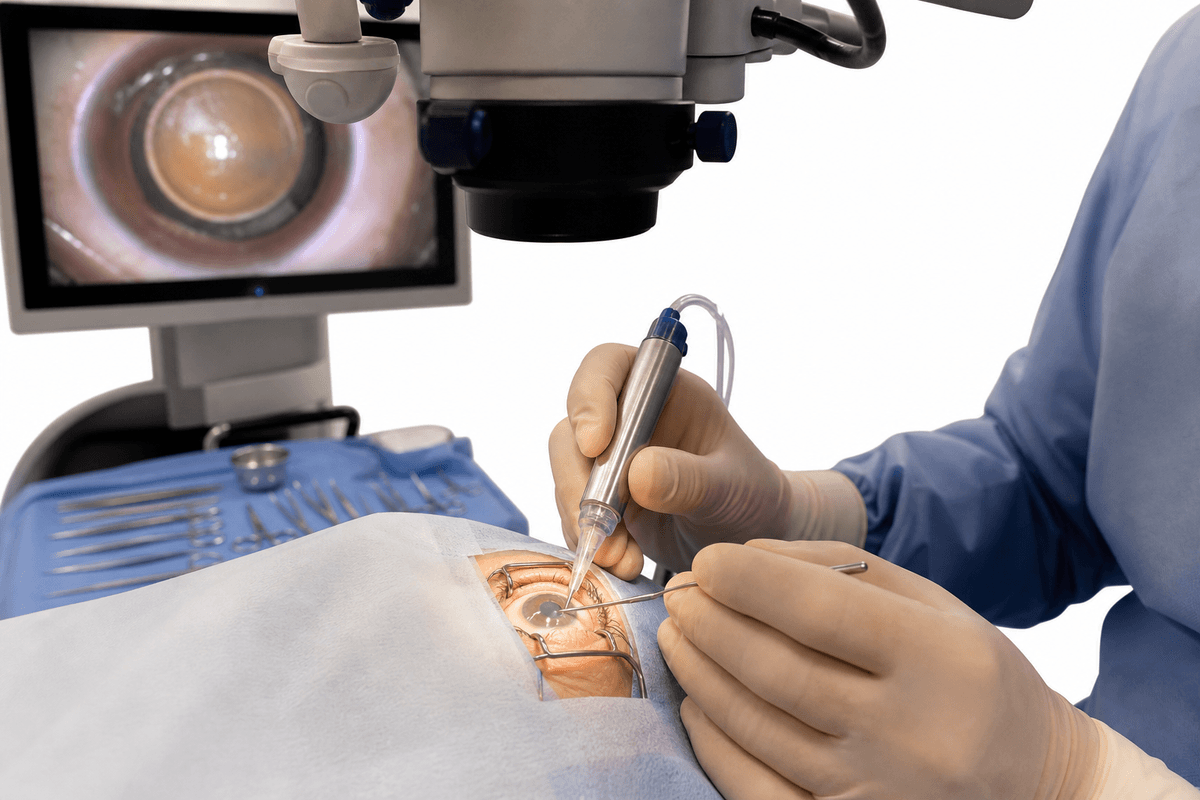
Performed by Dr. Praneeth Putti at Sharp Vision Eye Hospital
Phacoemulsification, commonly known as PHACO, is the gold standard cataract surgery technique available in Hyderabad that uses ultrasound energy to break up and remove cloudy lens tissue through a tiny incision. This minimally invasive procedure offers faster healing, reduced complications, and excellent visual outcomes compared to traditional cataract surgery. Dr. Praneeth Putti at Sharp Vision Eye Hospital specializes in performing advanced PHACO surgery with precision and care.
We believe in honest, upfront disclosure so you can make an informed decision.
A step-by-step look at what happens during this procedure.
A self-sealing micro-incision of 2.2-2.8mm is created at the edge of the cornea, allowing instrument access while maintaining eye structure integrity.
A circular opening is carefully made in the anterior lens capsule to access the cataractous lens while preserving the posterior capsule for IOL placement.
An ultrasonic probe emulsifies the cloudy lens into tiny fragments using high-frequency vibrations, which are then aspirated out through the same probe.
Remaining lens cortex material is thoroughly removed using irrigation and aspiration techniques to ensure a clean capsular bag for lens implantation.
A foldable intraocular lens is inserted through the micro-incision and positioned within the capsular bag, restoring clear focusing power to the eye.
A structured, patient-first approach from first consultation to full recovery.
Sharp Vision Eye Hospital conducts detailed biometry, corneal topography, and optical coherence tomography to select the optimal intraocular lens power and type for your individual visual needs.
We utilize the latest phacoemulsification systems with intelligent fluidics and torsional ultrasound technology, ensuring safer surgery with minimal corneal trauma and faster healing.
Dr. Praneeth Putti develops a customized surgical approach based on your cataract density, eye anatomy, and lifestyle requirements, including premium IOL options for astigmatism or presbyopia correction.
Our team provides structured follow-up care with scheduled examinations on day one, week one, and month one post-surgery, along with 24/7 accessibility for any concerns during recovery.
What to expect at each stage of your recovery journey.
Mild discomfort, watering, and light sensitivity are common. Vision may be blurry initially but begins improving within 24-48 hours. Use prescribed antibiotic and anti-inflammatory drops as directed, wear the protective eye shield while sleeping, and avoid rubbing the eye.
Vision continues to improve significantly with most patients achieving functional vision for daily activities. Avoid strenuous exercise, swimming, and dusty environments. Continue using eye drops as prescribed and attend scheduled follow-up appointments to monitor healing progress.
Vision stabilizes to near-final levels with minimal fluctuations. The eye is fully healed, and you can resume all normal activities including exercise. Your ophthalmologist will assess if prescription glasses are needed for fine-tuning distance or reading vision based on the IOL type implanted.
Over 98% of patients experience significant improvement in visual clarity, with most achieving 20/40 vision or better, enabling independent performance of daily activities without cataract-related blur or glare.
Patients report improved ability to read, drive safely, recognize faces, and enjoy hobbies with better color perception and contrast sensitivity that had been diminished by cataracts.
With advanced IOL options like toric, multifocal, or extended depth of focus lenses, many patients achieve functional vision at multiple distances with minimal or no need for corrective eyewear.
The implanted intraocular lens is permanent and does not degrade over time. While posterior capsule opacification may occur in 20-30% of cases years later, it is easily treated with a simple YAG laser capsulotomy procedure.
Let's clear up some of the most common myths about phacoemulsification / phaco.
Get a personalised assessment from an experienced specialist. Understand your options, ask your questions, and decide with confidence.