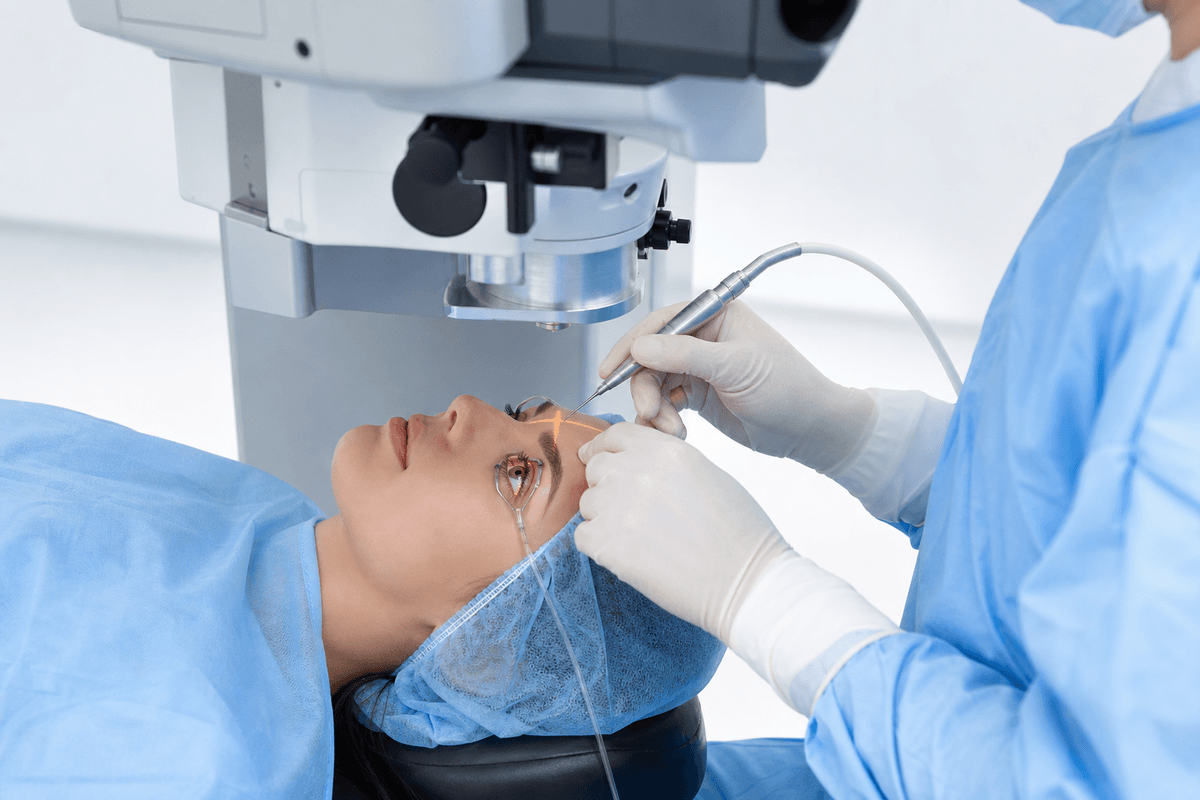
Performed by Dr. Praneeth Putti at Sharp Vision Eye Hospital
LASIK (Laser-Assisted In Situ Keratomileusis) is a procedure that uses a laser to reshape the cornea, the clear front surface of the eye. This reshaping helps light focus correctly on the retina, reducing or eliminating the need for glasses or contact lenses. Dr. Praneeth Putti evaluates each patient individually to determine if LASIK is a suitable option based on eye health, prescription stability, and corneal thickness.
We believe in honest, upfront disclosure so you can make an informed decision.
A step-by-step look at what happens during this procedure.
Numbing drops are placed in the eye to ensure comfort throughout the procedure. You remain awake but should not feel pain.
A thin flap is made on the surface of the cornea, either with a microkeratome blade or a femtosecond laser. This flap is gently lifted to expose the underlying corneal tissue.
An excimer laser removes microscopic layers of corneal tissue in a precise pattern based on your refractive error. This reshaping allows light to focus more accurately on the retina.
The corneal flap is carefully laid back into place. It adheres naturally without the need for stitches.
In most cases, both eyes are treated during the same session. The entire procedure typically takes 15 to 20 minutes for both eyes.
A structured, patient-first approach from first consultation to full recovery.
Sharp Vision Eye Hospital conducts detailed measurements of your cornea, pupil size, refractive error, and overall eye health to determine if LASIK is appropriate for you.
You receive clear information about what to expect, including realistic outcomes, possible risks, and alternatives, so you can make an informed decision.
The LASIK procedure is performed in a sterile, controlled setting with calibrated equipment to ensure precision and safety.
Follow-up visits are scheduled to monitor healing, check vision progress, and address any concerns during your recovery.
What to expect at each stage of your recovery journey.
Your eyes may feel gritty, watery, or sensitive to light for the first few hours. Vision is often blurry immediately after the procedure. Rest your eyes and avoid rubbing them. Timelines vary; follow individual instructions from your clinical team.
Vision typically improves within the first few days, though fluctuations are normal. Use prescribed eye drops to prevent infection and manage dryness. Avoid swimming, hot tubs, and eye makeup. Individual recovery varies.
Vision continues to stabilise over several weeks to months. Dry eye symptoms may persist and require ongoing treatment. Attend all scheduled follow-ups to monitor healing and address any concerns.
Many patients experience improved vision and rely less on corrective lenses for daily activities. However, some may still need glasses for certain tasks like reading or night driving, especially as they age.
LASIK aims to improve refractive error, but results vary. Some patients may have residual refractive error or need an enhancement procedure. Presbyopia, the age-related loss of near focusing, is not corrected by LASIK.
Vision can change over time due to natural aging, eye conditions like cataracts, or other factors unrelated to the procedure. LASIK does not prevent age-related eye conditions.
Dry eye symptoms are common after LASIK and can last months or, in some cases, become a long-term condition requiring ongoing management.
The right choice depends on your diagnosis, risks and circumstances — discussed with you at your consultation.
A laser procedure similar to LASIK but without creating a corneal flap. PRK may be considered for patients with thinner corneas or certain corneal irregularities. Recovery takes longer than LASIK.
A lens is surgically placed inside the eye, in front of the natural lens. This option may be considered for patients with higher refractive errors or those not suitable for laser procedures.
Non-surgical correction remains an effective, reversible option. It may be preferred if the risks of surgery outweigh the benefits, or if the refractive error is stable and well-managed with corrective lenses.
Let's clear up some of the most common myths about lasik.
Get a personalised assessment from an experienced specialist. Understand your options, ask your questions, and decide with confidence.